


Extracted from TA from Then to Now: Contextual Considerations
The material below will be incorporated into a book called TA from Then to Now: Contextual Considerati0ns, which is published within the TTN series of free books that I am producing as reviews and critiques of TA literature over the years. Existing books in this series are available free as ppfs and epubs at Julie’s website , or at Amazon at their cost if you want paperback or kindle).
© 2022 Julie Hay
I believe that a major contributor to objections about online working can be understood if we consider imagoes and Generation Z. As I explained in Chapter 9, young people tend to grow are used to interacting via screens the size of iPads and phones, so their imagoes work for such circumstances. However, older people may have imagoes that developed in the ways described by Berne (1963) – they contain family members (or whoever acted as family) and the individual then unconsciously projects those phantoms on to whoever is there currently.
My process for recognising this began as we moved into pandemic lockdowns, and I realised that I continued to see my great-grandson (who is part of Generation Alpha) regularly because he was living in Peru and connected with me online. This prompted me to reflect on how I have been working online for so many years, with students who would not have been able to travel to see me even without any lockdown. It also reminded me that when I first learned TA, I had to take an airline flight once a month and stay in a hotel, which was only possible because at that time I was employed by an airline. I was very conscious of how lucky I was, and how most other TA students do not work for airlines, and how some of them could not leave their own countries anyway even if they had enough money to do so.
I was also conscious of how I continued to be lucky, when groups of students paid for me to visit their countries and teach them TA. That stopped of course when Covid emerged, although it had in fact been stopped before that, by floods in India. In 2018 I got as far as Bombay, spent 24-hours in the airport, and came home again. As a result, I ended up organising and leading the first ever online ITAA Training Endorsement Workshop (TEW). In English we have a saying that ‘Every cloud has a silver lining’. Once lockdowns occurred I saw that others began to realise the possibilities of online – even though previously they had said it was not possible and even though our TA leaders at that time had refused to support the 2020 online conference that had been organised.
The above has been by way of background about why I thought we needed another TA concept to understand what was happening. It was obvious that stroking patterns had to change during lockdown but why were so many people not realising they could still get strokes online, provided they interacted with each other. I could not hug my great-grandson in Peru but we could still see and hear each other, and we could do that animatedly so the strokes had more impact. That, and watching my uncle (who was born before any of the Generations shown by Redmond) struggling with his mobile phone, and seeing my grandchildren (Generations Y and Z) with their phones, finally prompted me to recognise that the difficulty is due to how our imagoes have been formed. This also goes some way towards explaining why people of a certain age are so keen to stop working online and return to interacting in a way that is familiar for them.
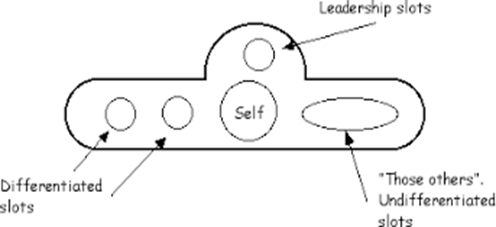
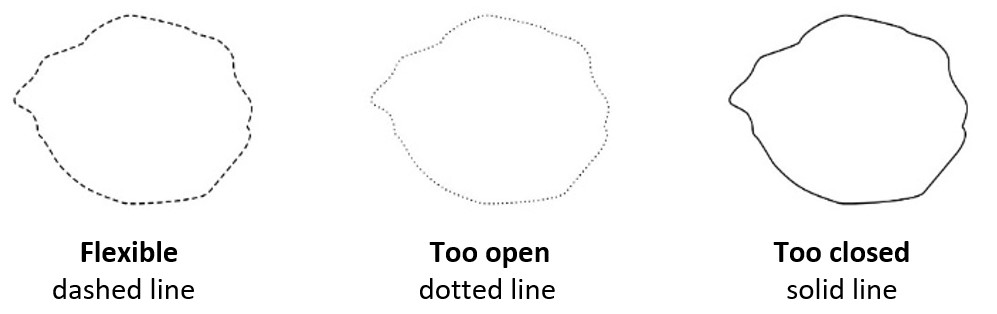
Berne drew imagoes rather like submarines with conning towers, which implies there is always a leader and a hierarchy. This is shown in Figure 34. It is easy to change the shape to reflect more levels of hierarchy. However, when I teach people about imagoes I prefer to show less distinct shapes and less definite boundaries, using dashed, dotted and solid lines, as shown in Figure 35, so that individuals can draw the imagoes in whatever way seems appropriate to them.
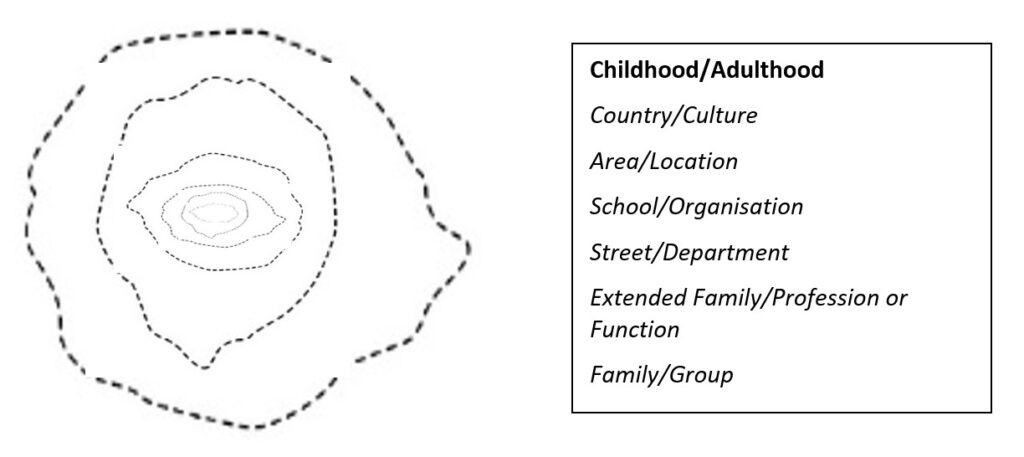
We can then think about the different levels of imagoes, such as: for our family/group, for our extended family or our profession or function, for our Street or department, for our school or organisation, for row area or location, and for our country and/or culture. My diagram for this is shown as Figure 36.
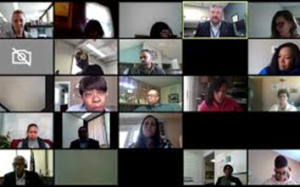
We can contrast this with our online imagoes, as shown in Figure 37. Items to note there are:
- we see only faces and sometimes shoulders although we generally see the person’s name;
- some people may have their camera turned off, which may be due to shyness but more likely a poor Internet connection, and they can still join in the conversation and everyone else is aware that they are there;
- there is no hierarchy – the system arranges the pictures and even if someone chooses the presenter option, this will make the picture larger for whoever speaks and not just for the leader.
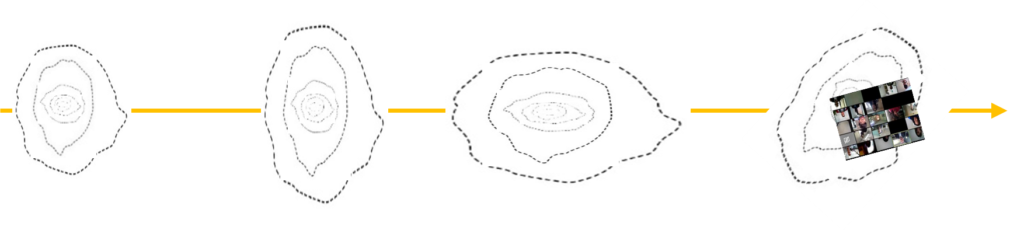
Finally, Figure 38 shows how I believe our imago changes over time. We begin with only one or two levels, such as our family and our Street village. Then we go to school and maybe travel within our own country or to other countries. After a while we move into adulthood and now we unconsciously expect that our job or profession will be like being in our family, our organisation or institute may be like our school, and so on. Finally, if we are in Generation Z, or if we are flexible enough, we have by now developed our own online imago and are no longer expecting to apply our original family imago whenever we are online. The added benefit of this is that we no longer expect to play online the same psychological games that we learned within our family of origin.
Reflection Questions: Developing an Online Imago
- You might begin this process by sketching your existing imago and thinking about the different levels at which it may operate subconsciously – i.e. put your unconscious onto a piece of paper so that you can step back and look at it and think about what it means.
- Then consider whether you already have an online imago. If so, how was it created – have you been engaging in interactive webinars or is your imago based on the kind of online presentation where you only see the presenter, or even worse, where the screen is filled with PowerPoint?
- If you feel that you still need to develop a positive and useful online imago, consider how you might do that. Where might you join interactive webinars? Why not set up your own interactive webinar with friends, family or colleagues.
- Finally, consider how having an online imago allows you to broaden the levels of your imago in terms of area/location and country/culture. What might there be in the family level of your imago that may be discouraging you from engaging in as much cross-cultural and intersectional activity as possible? What will you do about that?
References
Berne, E. (1963). The Structure and Dynamics of Organisations and Groups. Grove Press.
